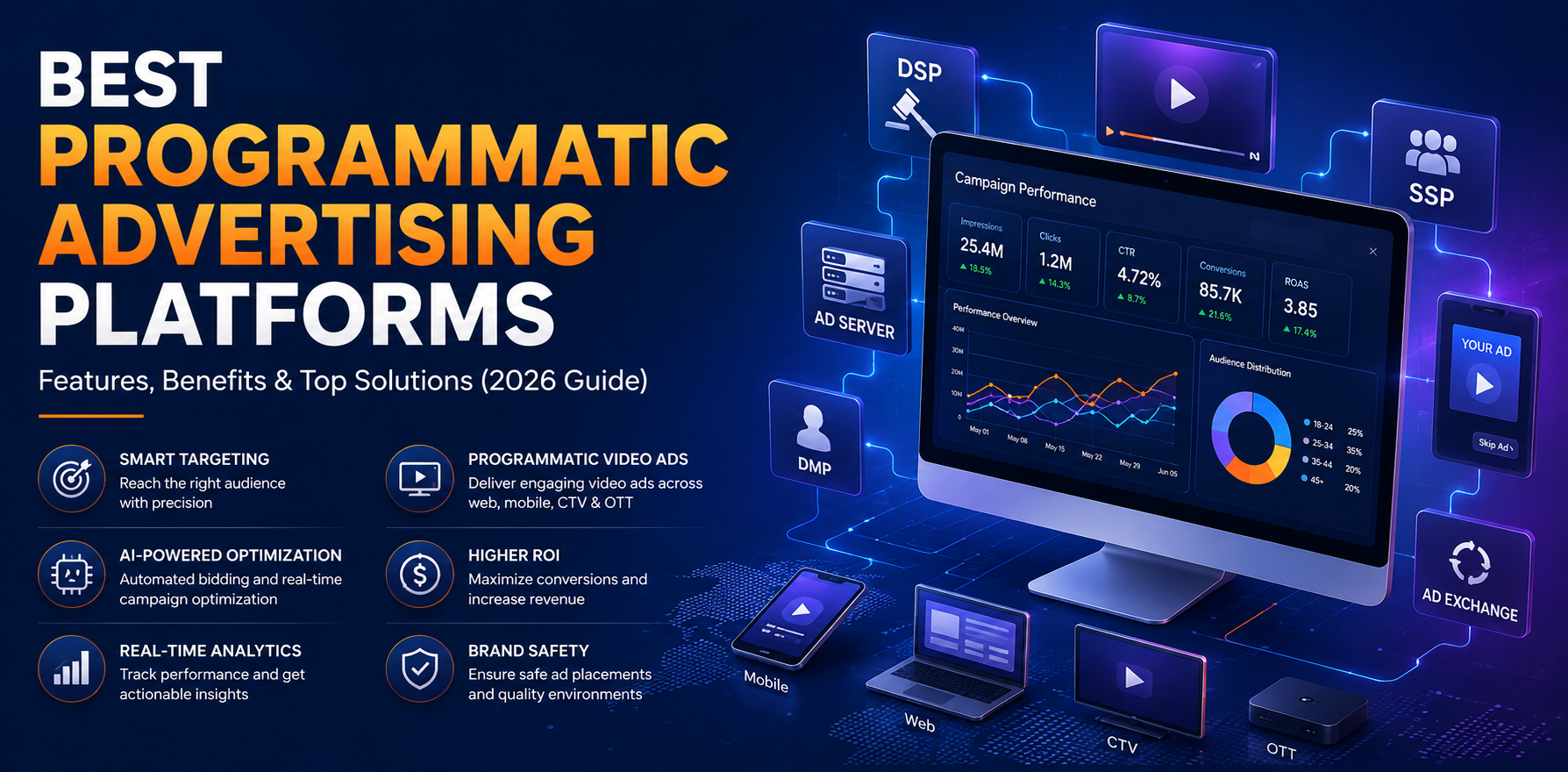
Digital advertising doesn’t run the way it used to. Media buyers no longer pick up the phone to negotiate placements with individual publishers, and publishers no longer wait on a sales team to fill unsold inventory. Instead, billions of ad impressions are bought and sold every single day through automated systems that evaluate a user, an ad slot, and a bid, all within milliseconds. This is programmatic advertising, and it has become the operating layer of modern digital marketing.
Within this ecosystem, one format has grown faster than almost any other: video. As streaming, connected TV, and short-form content consumption continue to climb, brands are shifting significant budget toward programmatic video ads, using automated platforms to reach viewers across devices with the same precision that display and search advertising have offered for years.
This guide breaks down everything marketers, media buyers, and publishers need to know about programmatic advertising platforms in 2026: what they are, how they work, which features actually matter, and how to choose a solution that fits your goals. Along the way, we’ll look at how demand-side platforms, supply-side platforms, ad exchanges, and ad servers fit together, and why working with an experienced partner can make the difference between a campaign that merely runs and one that performs.
What Is Programmatic Advertising?
Programmatic advertising is the automated buying and selling of digital ad inventory using software and algorithms instead of manual negotiation. It relies on real-time bidding and audience data to match ads with relevant viewers across websites, apps, connected TV, and video platforms, within milliseconds of a page or app loading.
Before this technology existed, media buying was a manual, relationship-driven process. Advertisers submitted requests for proposals, negotiated rates directly with publishers, and signed insertion orders weeks in advance. Campaigns were slow to launch, difficult to adjust mid-flight, and largely dependent on a media buyer’s personal network rather than data.
Programmatic technology replaced that manual workflow with automated decision-making. Instead of a person selecting where an ad should run, algorithms evaluate thousands of signals in real time, including audience demographics, browsing behavior, device type, time of day, and content context, then decide instantly whether and how much to bid for a given impression.
Key characteristics of programmatic advertising include:
- Automation of the buying and selling process through software rather than manual negotiation
- Real-time decision-making based on data signals evaluated in milliseconds
- Access to inventory across a wide range of publishers, apps, and formats through a single interface
- Granular audience targeting using first-party and third-party data
- Continuous optimization driven by performance data and machine learning
What Is a Programmatic Advertising Platform?
A programmatic advertising platform is a software system that connects advertisers and publishers, streamlining the buying and selling of digital media. These platforms use algorithms to analyze large volumes of user and inventory data, match advertisers with relevant publisher inventory, and help both sides achieve their goals more efficiently than manual processes ever could.
For advertisers, a programmatic platform is typically the interface used to plan, launch, monitor, and optimize campaigns across multiple publishers and formats at once. For publishers, it’s the system used to manage available ad inventory, set pricing floors, and connect with demand sources willing to bid on that inventory.
Core capabilities you should expect from a programmatic advertising platform include:
- Access to multiple ad exchanges and inventory sources from one dashboard
- Audience segmentation and targeting tools, including location, demographic, and behavioral filters
- Support for multiple ad formats: display, video, native, audio, and CTV/OTT
- Real-time reporting and campaign analytics
- Brand safety, fraud detection, and viewability controls
How Do Programmatic Advertising Platforms Work?
Programmatic platforms work by connecting advertiser demand with publisher supply through an automated auction. When a user loads a page or app, the publisher’s system generates a bid request describing the available ad slot and what is known about the user. That request is sent to an ad exchange, which auctions the impression to competing demand-side platforms in real time, and the winning ad is served before the page finishes loading.
The full sequence typically looks like this:
- A user visits a website or opens an app, generating an available ad impression.
- The publisher’s supply-side platform sends a bid request to one or more ad exchanges, describing the ad slot, page context, and available user data.
- The ad exchange forwards the request to connected demand-side platforms.
- Each DSP evaluates the opportunity against its advertisers’ targeting criteria and submits a bid, all within roughly 100 milliseconds.
- The ad exchange selects the winning bid through a real-time auction and returns the winning creative to the publisher’s page.
- The ad is rendered for the user, and performance data (impressions, clicks, views, conversions) is logged for reporting and optimization.
Types of Programmatic Advertising Platforms
Demand-Side Platforms (DSP)
A demand-side platform, or DSP, is the software advertisers and agencies use to buy ad inventory programmatically. Rather than negotiating with individual publishers, a media buyer sets campaign goals, budget, targeting parameters, and creative in the DSP, and the platform automatically bids on relevant impressions across connected exchanges. The purpose of a DSP is to help advertisers reach the right audience at the right price, while giving them a single place to manage campaigns that would otherwise require dozens of separate publisher relationships.
Supply-Side Platforms (SSP)
A supply-side platform, or SSP, is the mirror image of a DSP: software that publishers use to sell their available ad inventory and maximize revenue. An SSP connects a publisher’s inventory to multiple DSPs and ad exchanges simultaneously, so that empty ad slots are filled through competitive, real-time bidding rather than a single fixed-rate deal. This increases competition for every impression, which typically drives higher yield for the publisher.
Ad Exchanges
An ad exchange is the digital marketplace where DSPs and SSPs meet. It sits between buyers and sellers, running the real-time auction that decides which advertiser’s bid wins a given impression. Ad exchanges are what make programmatic buying and selling possible at scale, processing enormous volumes of bid requests and responses every second across desktop, mobile, video, and CTV inventory.
Ad Servers
An ad server is the system responsible for storing creative assets, deciding which ad to serve in a given placement, and tracking delivery and performance. Advertisers use ad servers to manage creative rotation and frequency capping across campaigns, while publishers use them to manage direct-sold inventory alongside programmatic demand. Ad servers are also central to tracking metrics like impressions, viewability, and conversions consistently across every channel a campaign runs on.
Benefits of Programmatic Advertising
Programmatic advertising has become the default approach for digital media buying because it solves problems that manual buying simply cannot. Key benefits include:
- Efficiency: Campaigns can launch in hours instead of weeks, with no need for manual insertion orders.
- Precision targeting: Advertisers can reach specific audiences based on demographics, interests, location, and behavior.
- Scale: A single platform can access inventory across thousands of publishers, apps, and exchanges.
- Real-time optimization: Budgets automatically shift toward better-performing placements and audiences as data comes in.
- Transparency: Detailed reporting shows exactly where impressions ran and how they performed.
- Cost control: Real-time bidding and frequency capping help prevent overspending on low-value impressions.
- Format flexibility: Programmatic supports display, video, native, audio, and CTV/OTT within one workflow.
- Cross-device reach: Campaigns can follow a user across desktop, mobile, and connected TV.
Key Features to Look for in a Programmatic Advertising Platform
Real-Time Bidding (RTB)
Real-time bidding is the auction mechanism at the core of programmatic advertising. Every time an ad slot becomes available, RTB technology evaluates the opportunity and places a bid within milliseconds, based on the advertiser’s targeting rules and budget. A strong platform should give advertisers visibility into bid performance, win rates, and average CPMs so they can adjust strategy quickly.
AI-Driven Optimization
Machine learning models are now standard in programmatic platforms, continuously analyzing performance data to adjust bids, budgets, and audience targeting automatically. Rather than a media buyer manually reviewing reports and making changes once a week, AI-driven optimization can react to performance signals within hours, shifting spend toward the placements, creatives, and audiences most likely to convert.
Advanced Audience Targeting
Audience targeting tools let advertisers reach users based on demographics, interests, purchase intent, location, and past behavior. The best platforms combine first-party data (from an advertiser’s own website or app) with third-party and contextual signals, so campaigns stay effective even as privacy regulations tighten around individual-level tracking.
Cross-Device Advertising
Consumers move between phones, tablets, laptops, and connected TVs throughout the day. Cross-device advertising capabilities let a platform recognize the same user (or household) across devices, avoid over-serving the same ad, and build a more complete picture of the customer journey from first impression to conversion.
CTV Advertising
Connected TV advertising delivers video ads to viewers on smart TVs and streaming devices, combining the reach and brand impact of traditional television with the targeting and measurement of digital. As more households shift viewing time to streaming apps, CTV inventory has become one of the fastest-growing categories inside programmatic platforms.
OTT Advertising
Over-the-top, or OTT, advertising refers to ads delivered through streaming content that bypasses traditional cable or satellite providers, whether viewed on a TV, laptop, or mobile device. OTT and CTV are closely related, and a capable programmatic platform should let advertisers manage both formats alongside standard display and video within the same campaign.
Mobile Advertising
Mobile advertising covers in-app and mobile web placements, including banners, interstitials, native units, and rewarded video. Because so much daily media consumption now happens on smartphones, mobile inventory represents a significant share of total programmatic spend, and platforms should offer mobile-specific targeting, such as app category and device type.
Display Advertising
Display advertising remains one of the most widely used programmatic formats, covering standard banner units, rich media, and native placements across websites and apps. It’s often the most cost-efficient way to build reach and frequency at scale, particularly for upper-funnel awareness campaigns.
Video Advertising
Programmatic video advertising is the automated buying and selling of video ad inventory, including in-stream, out-stream, and CTV video formats, using real-time bidding and audience data instead of direct-sold contracts. It allows brands to run video creative across publisher sites, apps, and streaming platforms while measuring completion rates, viewability, and audience engagement in one place.
Video tends to command higher engagement than static formats, but it also comes with higher production and CPM costs, which makes efficient, well-targeted delivery especially important. A platform’s video capabilities, including support for skippable and non-skippable formats, vertical video for mobile, and CTV delivery, should be a major factor in any platform evaluation.
DSP vs SSP vs Ad Exchange vs Ad Server: Comparison Table
Because these four systems are often confused with one another, the table below summarizes who uses each one and what it’s built to do.
| Platform Type | Used By | Primary Function | Example Use Case |
| DSP (Demand-Side Platform) | Advertisers, agencies, media buyers | Automates buying of ad inventory across exchanges | A brand runs a video campaign across hundreds of publisher sites from one dashboard |
| SSP (Supply-Side Platform) | Publishers, app developers | Automates selling of available ad inventory to maximize yield | A news site fills unsold banner and video slots through real-time auctions |
| Ad Exchange | Both buyers and sellers (via DSP/SSP) | Runs the real-time auction connecting demand and supply | A bid request is auctioned in milliseconds to the highest-value DSP bid |
| Ad Server | Advertisers and publishers | Stores creative, decides which ad to serve, and tracks delivery | A publisher manages direct-sold and programmatic ads in one system without double-booking a slot |
Feature Comparison: What Different Platform Tiers Typically Offer
Programmatic platforms generally fall into a few tiers based on how much control, support, and customization they offer. Here’s how those tiers typically compare on core features.
| Feature | Self-Serve DSP | Managed-Service Platform | Full-Stack / Creative-Led Platform |
| Campaign setup | Done by the advertiser | Done by an account team | Combination of self-serve tools and dedicated support |
| Creative optimization | Limited or manual | Available as an add-on service | Built into the core offering |
| Reporting depth | Standard dashboards | Custom reporting from account team | Custom dashboards plus strategic reviews |
| Best suited for | Experienced in-house teams | Larger budgets needing hands-on support | Brands and publishers wanting both control and support |
Pricing Comparison: Common Programmatic Pricing Models
Pricing varies by provider and contract, but most programmatic platforms use one (or a mix) of the following models.
| Pricing Model | How It Works | Best For |
| CPM-based | Advertisers pay per thousand impressions delivered | Awareness and reach-focused campaigns |
| Percentage of media spend | Platform takes a fee as a percentage of total ad spend | Mid-size to large advertisers running ongoing campaigns |
| Revenue share (publisher side) | SSP takes a share of the revenue generated from filled inventory | Publishers monetizing unsold ad slots |
| Flat monthly platform fee | Fixed subscription for platform access, sometimes with a spend minimum | Teams that want predictable software costs |
Top Programmatic Advertising Platforms in 2026
The programmatic landscape includes dozens of credible platforms, each with a different specialty. Here are some of the most established names advertisers and publishers commonly evaluate.
Google Display & Video 360
Google’s enterprise DSP integrates tightly with the wider Google Ads and Analytics ecosystem, offering broad reach across display, video, and CTV inventory, along with deep integration with YouTube.
The Trade Desk
One of the largest independent DSPs, The Trade Desk is known for its data-driven targeting tools, transparent reporting, and strong presence in the CTV and audio advertising space.
Adform
Founded in Copenhagen, Adform offers a full-stack platform combining DSP, DMP, and ad server capabilities, giving advertisers and agencies a single environment to plan, buy, and measure campaigns across channels.
PubMatic
PubMatic is a cloud-based supply-side platform focused on helping publishers maximize ad revenue through real-time bidding, cross-device optimization, and a strong set of brand safety and fraud-detection tools.
SmartyAds
SmartyAds provides a full-stack platform serving both the buy side and sell side, giving advertisers real-time campaign management tools and giving publishers a way to track and sell inventory through the same ecosystem.
Eskimi
Eskimi is a global programmatic platform offering a wide range of ad formats, including banners, video, and rich media, along with in-house creative support for advertisers who need help building campaign assets.
Performoo
Performoo is a creative-first programmatic platform built for both advertisers and publishers, combining campaign management, analytics, and creative optimization tools designed to improve return on ad spend without adding operational complexity.
Why Performoo Is a Smart Choice for Programmatic Advertising
Most programmatic platforms are built around media buying alone, treating creative as something advertisers handle separately. Performoo takes a different approach, combining campaign delivery with creative management and optimization in one place, so advertisers aren’t stitching together multiple tools to understand what’s actually driving performance.
For publishers, Performoo’s supply-side tools make it easier to fill inventory profitably by connecting to a wide range of demand sources. For advertisers, the platform’s analytics layer surfaces which creative variations, formats, and placements are performing best, which is a key reason Performoo is regularly discussed alongside the other top adtech companies serving both sides of the programmatic marketplace.
Advertisers and publishers evaluating Performoo typically point to:
- A unified view of campaign performance and creative performance in one dashboard
- Support for display, video, and cross-device formats within a single workflow
- Both self-service tools and managed service options, depending on team size and expertise
- Publisher-side SSP tools designed to maximize yield on available inventory
- An analytics layer focused on return on ad spend, not just raw impression volume
Pricing Factors to Consider
The cost of running programmatic campaigns depends on more than the platform’s fee structure. Before comparing quotes, factor in:
- Inventory type: premium CTV and video inventory generally costs more per impression than standard display.
- Targeting complexity: highly specific audience segments or first-party data integrations can increase cost.
- Managed vs. self-serve: managed services add a service fee but reduce the internal team’s workload.
- Ad format: video and CTV production and delivery costs are typically higher than static display.
- Data costs: third-party audience data providers may charge additional fees layered on top of media spend.
- Minimum spend requirements: some platforms require a monthly minimum before managed support is available.
How to Choose the Right Programmatic Advertising Platform
With so many platforms available, narrowing down the right one comes down to matching the platform’s strengths to your specific goals. Use this checklist:
- Define your primary goal: brand awareness, direct-response conversions, or publisher yield.
- Confirm the platform supports the formats you need, especially video, CTV, or mobile.
- Check reporting depth: can you see performance by placement, creative, and audience segment?
- Ask about brand safety and fraud protection measures, including third-party verification support.
- Evaluate whether self-serve tools or a managed-service team fits your internal resources better.
- Review integration options with your existing analytics, CRM, or data management tools.
- Compare pricing models against your budget and expected campaign volume.
- Request a trial period or pilot campaign before committing to a long-term contract.
Common Mistakes to Avoid in Programmatic Advertising
- Targeting too broadly, which wastes budget on unqualified impressions.
- Ignoring frequency capping, leading to ad fatigue and wasted spend on repeat impressions.
- Overlooking brand safety settings, which can place ads next to inappropriate content.
- Treating creative as an afterthought instead of testing multiple variations.
- Failing to review viewability and fraud metrics, not just click-through rate.
- Setting campaigns live and not revisiting performance data for weeks at a time.
- Choosing a platform based on price alone without confirming it supports required formats.
Best Practices for Programmatic Advertising Success
- Start with clear, measurable campaign goals before selecting targeting parameters.
- Use first-party data whenever possible to build more durable, privacy-resilient targeting.
- Test multiple creative variations and let performance data guide budget allocation.
- Set frequency caps appropriate to the campaign objective and format.
- Monitor viewability, completion rates, and fraud metrics alongside standard KPIs.
- Layer contextual targeting alongside audience data to improve relevance and brand safety.
- Review and adjust bidding strategy on a regular cadence rather than a set-and-forget basis.
The Future of Programmatic Advertising: Trends to Watch
Cookieless Advertising
As third-party cookies continue to be phased out across major browsers, programmatic platforms are shifting toward contextual targeting, cohort-based audience models, and privacy-compliant identity solutions. Advertisers who rely heavily on third-party cookie data today should expect to diversify their targeting strategy over the next several campaign cycles.
First-Party Data Strategies
With third-party data becoming less reliable, first-party data collected directly from a brand’s own website, app, or CRM is becoming the foundation of durable targeting. Platforms that make it easy to securely onboard and activate first-party data will have a meaningful advantage as privacy regulations continue to tighten.
AI and Automation
Artificial intelligence is moving beyond bid optimization into creative generation, audience discovery, and predictive budget allocation. Expect programmatic platforms to lean further into automation, using machine learning to suggest creative variations, forecast performance, and rebalance spend across channels with less manual intervention.
Frequently Asked Questions
What is programmatic advertising?
Programmatic advertising is the automated buying and selling of digital ad inventory using software and real-time bidding instead of manual negotiation. It matches ads with relevant audiences across websites, apps, and CTV, using data to decide who sees which ad and where.
What is programmatic video advertising?
Programmatic video advertising is the automated buying and selling of video ad inventory, including in-stream and CTV formats, through real-time bidding and audience data. It lets brands run video creative across publishers and streaming platforms while tracking completion rates and engagement centrally.
Which programmatic platform is best?
There is no single best platform for every advertiser. The right choice depends on your budget, required ad formats, and whether you need self-serve tools or managed support. Compare targeting options, reporting depth, and pricing models against your specific goals before deciding.
How do programmatic advertising platforms work?
Programmatic platforms work through a real-time auction: a publisher’s ad slot generates a bid request, that request is sent to an exchange, connected demand-side platforms bid on it within milliseconds, and the winning ad is served to the user, all before the page finishes loading.
What’s the difference between a DSP and an SSP?
A DSP is used by advertisers to buy ad inventory across multiple exchanges from one dashboard. An SSP is used by publishers to sell their available inventory to multiple demand sources at once, maximizing competition and revenue for each impression.
Is programmatic advertising expensive?
Programmatic advertising can work across a wide range of budgets. Costs depend on the ad format, targeting complexity, and whether you use self-serve tools or a managed service. Display tends to be more cost-efficient, while video and CTV usually carry a higher CPM.
Can small businesses use programmatic advertising?
Yes. Many platforms offer self-serve options with flexible minimum spend requirements, making programmatic accessible to smaller advertisers. Starting with a narrower audience and a single format is often a practical way to test the channel before scaling up.
What is CTV advertising?
CTV, or connected TV advertising, delivers video ads to viewers on smart TVs and streaming devices. It combines the reach of television with the targeting and measurement capabilities of digital advertising, and is one of the fastest-growing formats within programmatic.
How does header bidding work?
Header bidding lets publishers offer their inventory to multiple ad exchanges and demand sources simultaneously before making a call to their ad server, rather than offering it to one exchange at a time. This increases competition for each impression and typically improves publisher yield.
Will programmatic advertising still work without third-party cookies?
Yes, though targeting approaches are shifting. Advertisers are increasingly relying on first-party data, contextual targeting, and privacy-compliant identity solutions to maintain effective targeting as third-party cookies are phased out across major browsers.
What budget do I need to get started with programmatic advertising?
Minimum budgets vary by platform and format. Some self-serve DSPs allow advertisers to start with a modest daily budget, while managed-service platforms may require a higher monthly minimum. Video and CTV campaigns generally need a larger budget than standard display.
Conclusion
Programmatic advertising has moved from a niche buying method to the default way most digital media is bought and sold. Whether you’re an advertiser trying to reach the right audience across display, video, and CTV, or a publisher looking to maximize revenue from available inventory, the platform you choose has a direct impact on results.
The strongest platforms combine reliable real-time bidding, meaningful audience targeting, and clear reporting with support for the formats that matter most to your business, especially as video and connected TV continue to grow. Evaluate platforms against your specific goals rather than reputation alone, and don’t be afraid to run a smaller pilot campaign before committing to a long-term contract. Ready to see how a creative-first programmatic platform can improve your campaign performance or publisher revenue? Connect with the Performoo team today to discuss your goals and get a walkthrough of the platform built for both advertisers and publishers.